Ready for some drills now that you know the basics of this game?? I was too in the beginning and now set aside 1 day a week with friends to practice the basics which has greatly helped us all improve. I will include a basic pickleball printable of these at the bottom too so you can bring it with you and remember what you wanted to practice.

The Best Pickleball Drills
We talk all about how to play pickleball on our blog so you can get started playing this super fun game. That said, the fastest way to improve isn’t just playing games it’s practicing simple, focused drills that build muscle memory and confidence. Beginner pickleball drills help you learn control, placement, footwork, and strategy without the pressure of keeping score.
This article walks through a variety of easy, effective drills for beginners, broken down by skill area. Whether you’re practicing solo, with a partner, or in a group, these drills will help you improve faster and enjoy the game more.
Why Drills Matter for Beginner Pickleball Players
Many new players jump straight into games, which is fun but drills are where real improvement happens. Drills allow you to repeat the same motion over and over, helping your body learn proper technique. They also reduce the chaos of a live game, letting you focus on one skill at a time. Beginner drills are especially helpful for: Improving consistency and accuracy, Learning control instead of power, Developing confidence at the kitchen line and Understanding basic shot selection. Even 15–20 minutes of drilling before open play can dramatically improve your performance.
Cooperative Baseline Drill
One of the most important Pickleball Tips for brand-new players is to drill from the furthest spots in the court. You do this with both players standing at the baseline and gently rally the ball back and forth, aiming for consistency rather than speed. It will help you improve your smooth swings, keep the ball in play and improving your forehand and backhand control. It builds hand-eye coordination and teaches you to control the paddle face, which is essential before moving closer to the net.
Crosscourt Groundstroke Drill
Instead of hitting straight ahead, players rally diagonally from corner to corner. How it works: Player A hits crosscourt, Player B returns crosscourt – Continue without switching sides This helps because crosscourt shots give you more margin for error and are commonly used in real games, making this a practical beginner drill. Then switch sides. You can do this while both are at the kitchen line, and another when both are at the baseline, both are important skills to have.
Dinking Drills
A Straight-On Dink Drill is where both players stand at the kitchen line directly across from each other and the basics in pickleball drills for beginners. Gently dink the ball back and forth without stepping into the kitchen. Focus on: soft hands, controlled paddle angle and letting the ball bounce. Once you get to the point where you are missing very few, try to move the other player around a bit from side to side. Crosscourt Dinking Drill is where players stand diagonally across from each other at the kitchen line. Crosscourt dinks travel farther and higher over the net, giving beginners more forgiveness while learning control.
Serving Drills
Serving is the only shot you fully control, making it a great place to focus early practice. Place targets (cones, towels, or water bottles) in the service box. Serve 10 balls and try to land as many as possible near the target in order to build confidence and consistency without worrying about power. Deep Serve Drill is a good one where the goal here is depth, not speed. Aim every serve toward the back third of the service box. Deep serves push opponents back, giving you more time to get to the net. You can refer to our. Pickleball Return Serve Drills in this case.
Deep Return Drill
Have one player serve while the other focuses only on returning deep. Focus on: height over the net, depth to the baseline and very controlled swings. A deep return keeps your opponent back and allows you time to move forward to the kitchen line. One other thing you can incorporate with a deep return is a lob. You can check out our pickleball lob drills to practice that one.
Resetting Drill
Have one player drive the ball at the other who is at the kitchen who will hold their paddle at a 5 for Pickleball Reset Drills (softer, number is out of 10 which would be holding it very tight) and block the ball but send it back to the other side softly, ideally as a dink barely over the net. This skill is very important to slow down the play when you are in a hands battle or playing with players who only want to hit hard. Typically those who know how to play a “soft game” will prevail over slammers.
Lob Drills
If you are new to a pickleball lob shot, it is a great option to use now and then to catch your opponents off guard. You can lob at the kitchen when there is a lot of back and forth dinking and you need to change it up. Have a lob come at you at the back of the court? Lob it back to surprise them.
The best way to start to drill this is to both dink at the net 3x each or so and then you lob it over the other side’s head, preferably to their backhand (it is much harder to return that way). The person on the other side practices returning that lob by turning, running, and either lobbing back, dinking or doing a drive and you reset to a dink once again continuing the drill.
Pickleball Drills PDF
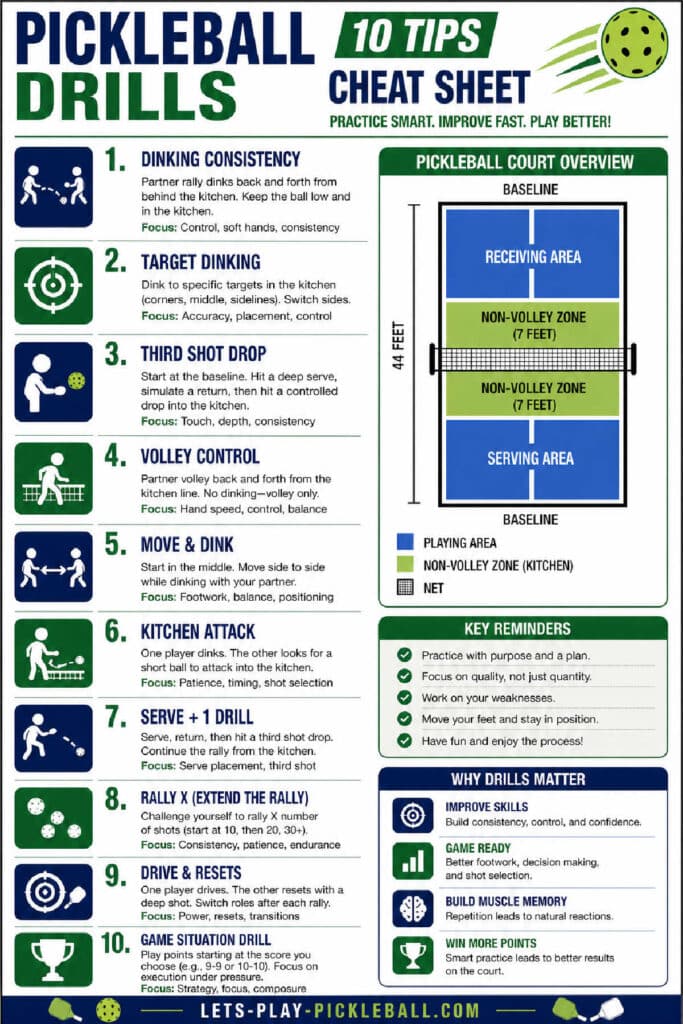
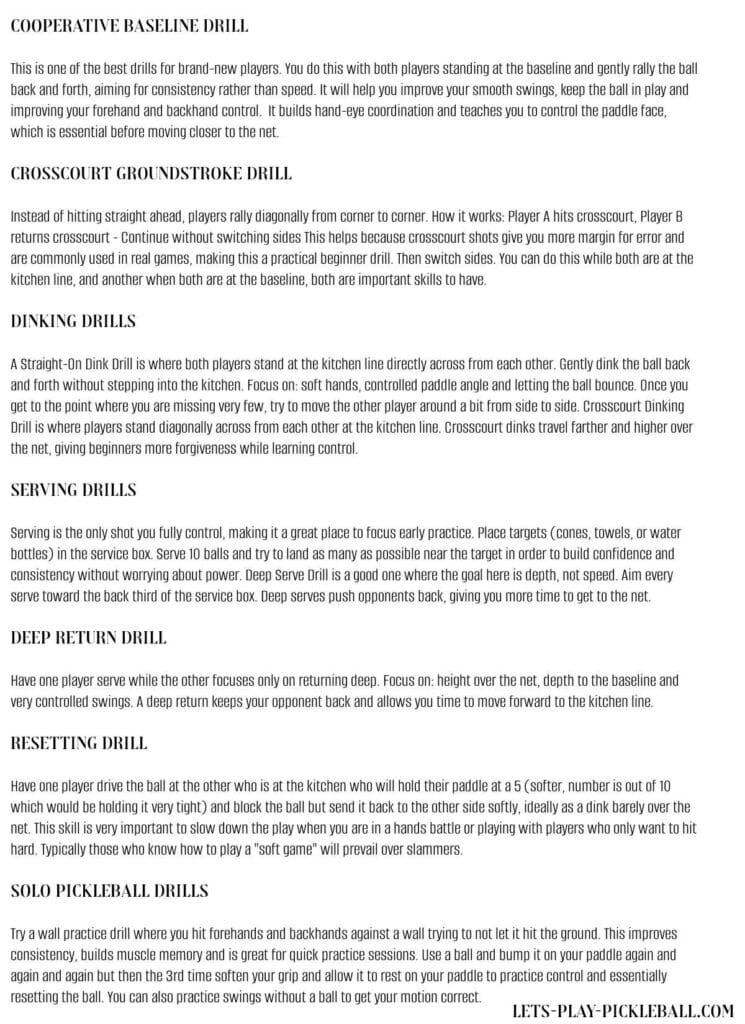
If you would like all of these beginner drills on a page, you can print our pickleball drills pdf page that is above (in color) here. You can download our (black and white) pickleball drill printable below. It is handy to have in order to take with you and remind yourself of each one, check them off when mastered so you can then move on to others.
And then we have tips on a fast one like pickleball volley drills. You want fast hands for this so I would suggest waiting until later to incorporate this skill, but is needed for 3.5+ play a lot.
Solo Pickleball Drills
You don’t always need a partner to practice. If you don’t have a partner try a wall practice drill where you hit forehands and backhands against a wall trying to not let it hit the ground. This improves consistency, builds muscle memory and is great for quick practice sessions. Use a ball and bump it on your paddle again and again and again but then the 3rd time soften your grip and allow it to rest on your paddle to practice control and essentially resetting the ball. You can also practice swings without a ball to get your motion correct.
Tips for Getting the Most Out of Beginner Drills
- Keep drills cooperative, not competitive
- Start slow and increase pace gradually
- Focus on consistency before power
- Practice short sessions often
Other Pickleball Printables You’ll love
Once you have been working on drilling yourself and with friends you should set up games with friends. If you have more than 1 court full you can grab our round robin pickleball printable to switch up and play with one another ever 12 minutes so everyone gets a chance.
Having a pickleball bracket sheet is fun to use too with a group where games are played and you can keep track of the winners. Those teams move on to play with the other winners until 1 set is on top!