A singles match begins with a coin toss or another method to decide which player serves first. The starting score is always called as zero zero before the first serve. Unlike doubles, where three numbers are used in scoring, singles uses only two numbers. The server always calls their score first followed by the receiver’s score. For example, if the server has three points and the opponent has two, the score is called three two.
Rules for Pickleball Singles
1 – Pickleball serving rules follow a clear pattern that is easy to learn (and less confusing than doubles). The server must stand behind the baseline and hit the serve diagonally into the opponent’s service box. The serve must be made underhand with the paddle contacting the ball below waist level. The serve must also travel in an upward motion and land beyond the non volley zone, also known as the kitchen. If the serve lands in the wrong box or does not clear the kitchen line, it is considered a fault.
2 – How to Score Pickleball is important of course. In this case, the serving position depends on the server’s score. When the server’s score is an even number, they serve from the right side of the court. When the score is odd, they serve from the left side. This pattern continues throughout the game and helps players keep track of where they should be standing. If the server wins the point, they switch sides and serve again. If the server loses the point, the serve goes to the opponent.
- Scoring in singles is straightforward. Only the serving player can score points. If the server wins the rally, they earn a point and continue serving. If the receiver wins the rally, they do not score a point but gain the right to serve. Games are typically played to eleven points, and a player must win by at least two points. In some cases, games may be played to fifteen or twenty one depending on the format.
4 – One of the most important Pickleball Rules in singles is the double bounce rule. After the serve, the receiving player must let the ball bounce before returning it. Then the serving player must also let the return bounce before hitting it. After these two bounces have occurred, both players are free to hit the ball in the air or after a bounce. This rule prevents players from rushing the net too quickly and creates longer rallies.
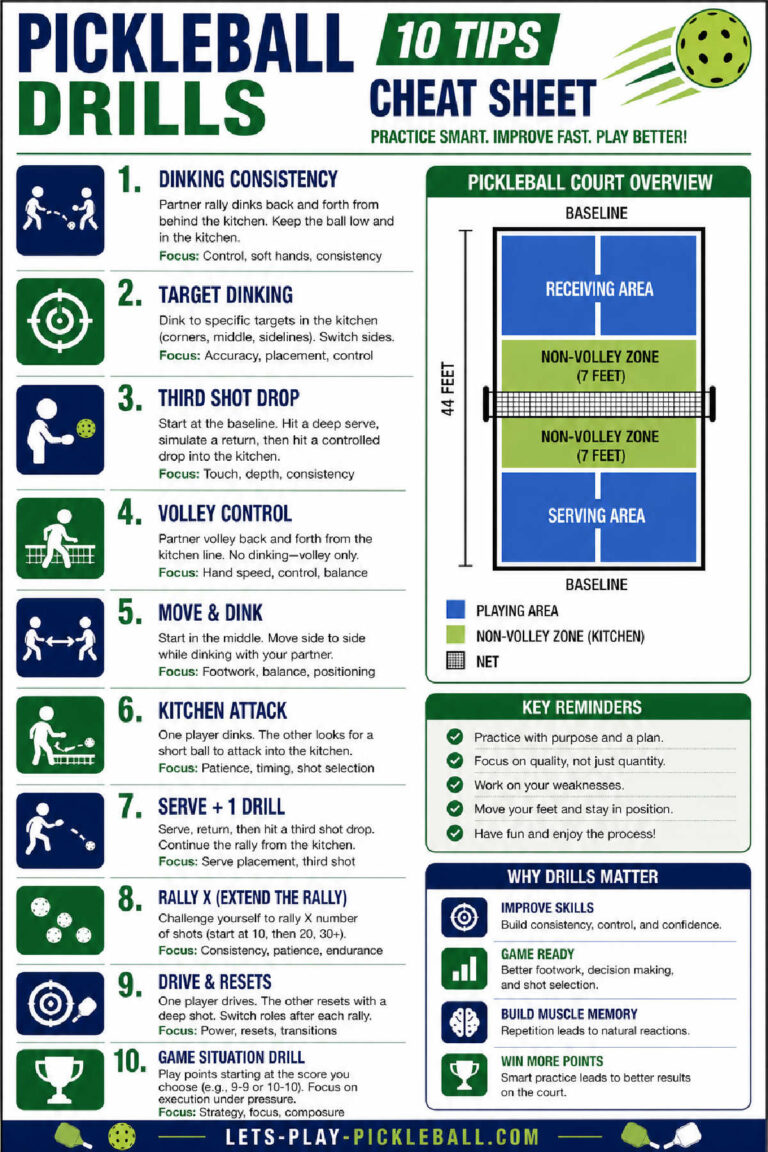
5 – The non volley zone, or Pickleball Kitchen Rules plays a key role in singles just as it does in doubles (and are the same either way). Players are not allowed to hit a volley while standing inside the kitchen or touching the kitchen line. A volley means hitting the ball out of the air before it bounces. However, players are allowed to enter the kitchen to hit a ball that has bounced. After hitting the ball, they must exit the kitchen before attempting a volley. This rule helps maintain fairness and prevents overly aggressive net play.
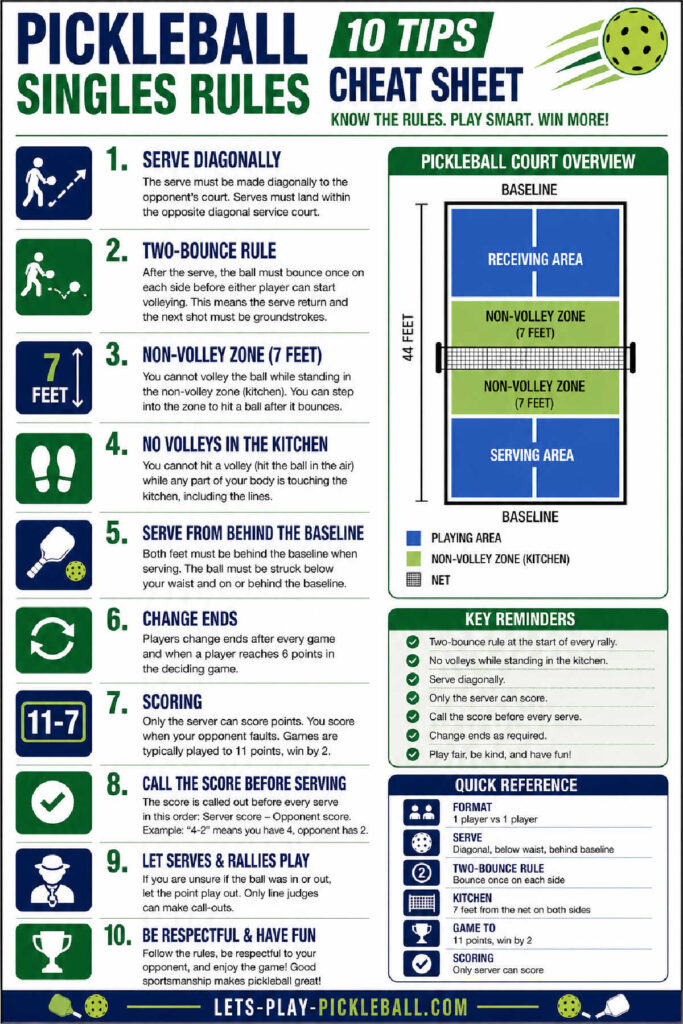
If you would like a print out like above with these on it, I get it. You can download our pickleball singles rules pdf here and keep it on hand. It is nice at the beginning to refer to this or that as a good reminder. You want to play correctly from day one or you will get into bad habits for sure.
Pickleball Singles Faults
Faults in singles occur when a player breaks any of the rules. 4 common faults include hitting the ball out of bounds, failing to clear the net, volleying in the kitchen, or serving incorrectly. A fault results in a loss of serve or no point awarded depending on who made the error. Keeping unforced errors low is especially important in singles because each point relies entirely on individual performance.
Court positioning is another important aspect of singles play. Because one player must cover the entire court, movement and anticipation are critical. Players often return to the center of the court after each shot to be in the best position for the next return. Strategic shot placement such as hitting deep shots or aiming for open areas can force opponents out of position and create opportunities to win points.
Overall, pickleball singles rules are simple to learn but require focus and consistency to master. By understanding serving patterns, scoring, the double bounce rule, and kitchen restrictions, you can build a strong foundation for competitive play. Once you have these down find some Pickleball Open Play where others your level want to practice and go for it, practice makes perfect!